Time:2026-11-19 10:45:01 Number of Clicks:
Both telescopic stackers and radial stackers build bulk stockpiles, but they do it in fundamentally different ways. A telescopic stacker extends its boom inward and outward while the machine stays in one place; a radial stacker keeps a fixed boom length and swings around a pivot point to form a conical pile. The choice affects the shape of the stockpile, how much yard area the machine needs, and how easily the layout can be changed later.
This article compares the two configurations on stockpile geometry, capacity, footprint, mobility and investment, and sets out the criteria that decide which one fits a given site. For the equipment range, see the stacker product center and the ZR-SF telescopic stacker and tracked radial stacker product pages. For feeding arrangements, see the hopper feeder range.
A telescopic stacker uses a hydraulic telescopic conveyor on a wheeled chassis. The boom extends and retracts while the machine remains parked, and the whole upper structure slews 360°. Because the discharge point moves in and out as well as around, the operator can build a long, rectangular stockpile with a controlled cross-section and place material exactly where it is needed.
ZOOMRY ZR-SF series telescopic stackers cover belt widths of 800 to 1,600 mm and capacities of 500 to 3,500 m³/h. The telescopic travel is 10–22 m, maximum inclination 18°, and stacking height up to 20 m. Travel speed is up to 20 m/min with a turning radius of at least 8 m.
A radial stacker has a boom of fixed length that slews around a central pivot. The discharge point traces an arc, so the pile grows outward as a cone or a radial row. The machine itself moves on crawlers or wheels between positions, but the stacking motion at each position is rotation, not extension.
ZOOMRY tracked radial stackers cover 800–1,600 mm belt widths and 450–3,500 m³/h, with stacking height up to 20 m and 360° continuous rotation. Ground pressure is below 80 kPa and the chassis remains stable on slopes up to 35°, which is useful on unset mine and quarry ground.
| Characteristic | Telescopic stacker | Radial stacker |
|---|---|---|
| Stockpile shape | Long rectangular or windrow, controlled cross-section | Conical or radial row around a pivot |
| Boom movement | Hydraulic extension plus 360° slew | Fixed length, 360° slew around a pivot |
| Typical capacity | 500–3,500 m³/h (ZR-SF) | 450–3,500 m³/h (ZR tracked) |
| Belt width | 800–1,600 mm | 800–1,600 mm |
| Stacking height | Up to 20 m | Up to 20 m |
| Maximum inclination | 18° | 20° |
| Yard footprint | Long, narrow strip; efficient use of linear space | Circular sector; needs clear radius around the pivot |
| Mobility | Wheeled, travels at up to 20 m/min | Tracked or wheeled, moves between pile positions |
| Ground condition | Prepared, level yard surface | Handles unfinished ground; below 80 kPa ground pressure |
| Best for | Long stockpiles, blending beds, frequent layout changes | Single-material piles, mining and quarry sites, uneven ground |
The telescopic configuration is the right choice when:
ZR-SF models are specified by belt width and capacity: ZR80SF at 500 m³/h on an 800 mm belt, ZR120SF at 1,500 m³/h on 1,200 mm, and ZR160SF at 3,500 m³/h on 1,600 mm. All models accept truck, conveyor or hopper feeding. For sites where material arrives by truck, pair the stacker with a hopper feeder to keep a steady feed to the boom.
The radial configuration is the right choice when:
The radial configuration is less suited to long blending beds: the discharge point follows an arc, so producing a uniform rectangular cross-section takes more repositioning than with a telescopic boom.
A telescopic stacker changes the length of its boom to place material, which suits long rectangular stockpiles. A radial stacker keeps a fixed boom length and slews around a pivot, which suits conical piles built from one position.
Both can reach the same upper range: ZOOMRY telescopic stackers run from 500 to 3,500 m³/h and tracked radial stackers from 450 to 3,500 m³/h. Capacity is set mainly by belt width, belt speed and material density, not by the stacking geometry.
Yes, by forming a series of overlapping radial rows and then moving the machine along the pile. It takes more repositioning than a telescopic boom, so for a continuous long bed the telescopic configuration is usually more efficient.
Both configurations can stack up to 20 m. Telescopic ZR-SF models operate at a maximum inclination of 18°, while tracked radial units are specified at 20°.
A wheeled telescopic stacker works best on a level, prepared surface. A tracked radial stacker is designed for unfinished ground, with ground pressure below 80 kPa and stability on slopes up to 35°.
Both can be fed by truck, conveyor or hopper. Telescopic ZR-SF models list all three as standard feeding modes. Where trucks deliver the material, a hopper feeder provides a controlled feed to the boom conveyor.
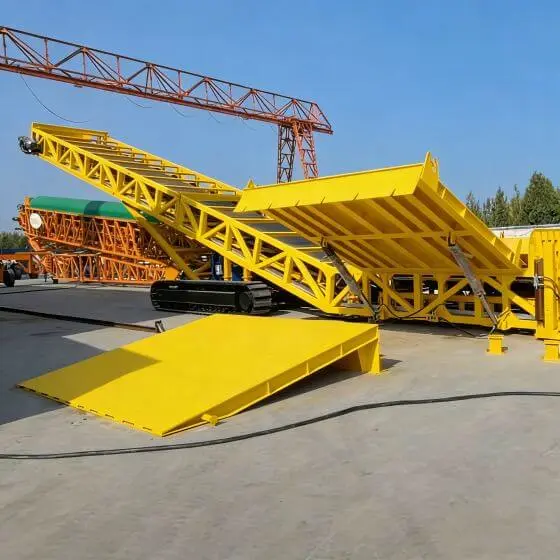
Truck unloading system with dry fog dust suppression and negative pres...
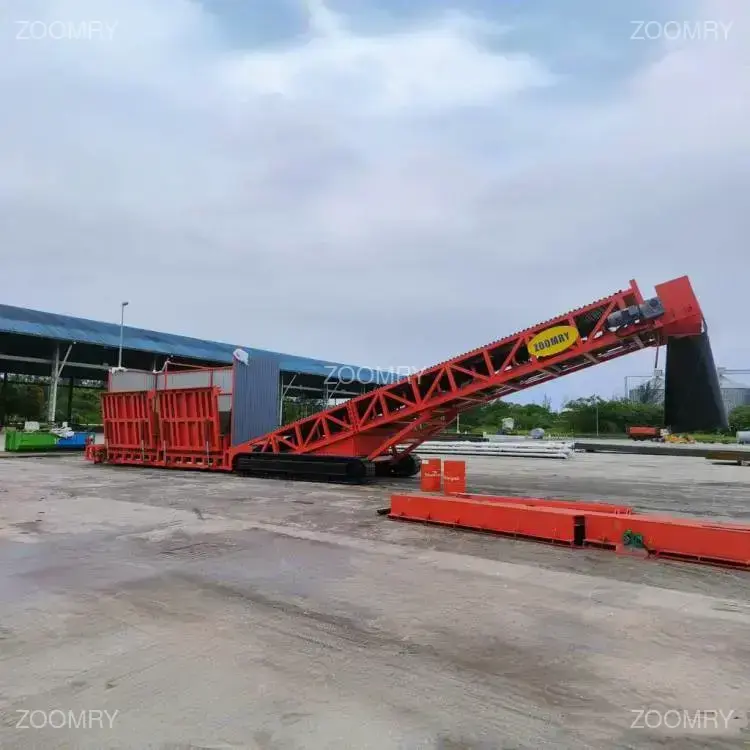
ZRLD-TU1400 tracked 4-lane truck unloader for simultaneous unloading o...
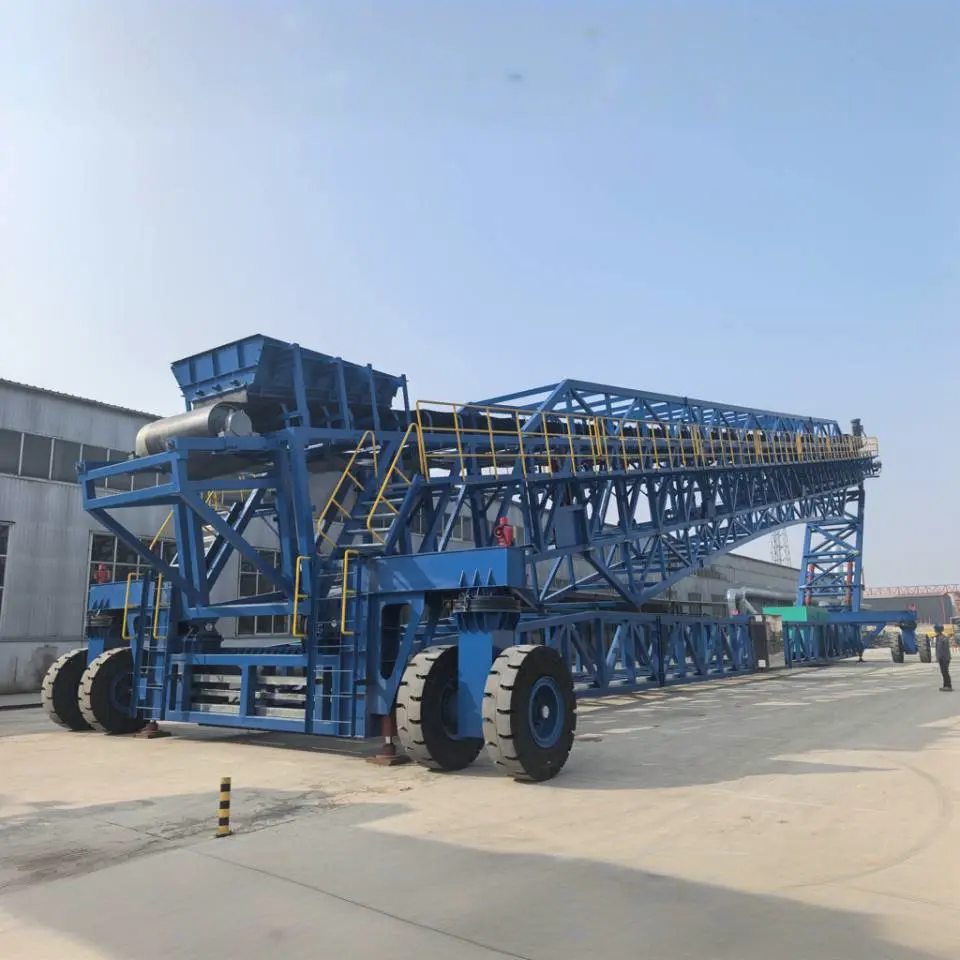
Shiploader unloader for loading and unloading coal, iron ore and grain...
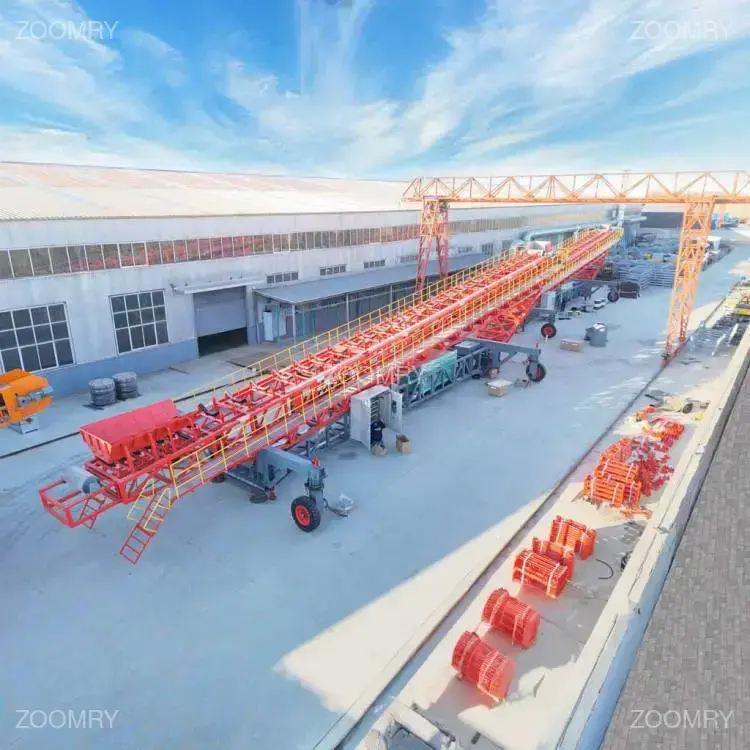
Wheel mobile shiploader for paved quays and multi-berth operation. Sel...

Enter your email to contact us quickly!
Copyright © 2002-2026 Zoomry Group Company Limited 非商用版本 AI Index