Time:2026-11-25 09:56:49 Number of Clicks:
In mining, the conveyor belt is the part of the system that meets the material. The frame, drives and structure can be engineered correctly and still fail early if the belt type is wrong for the ore, the incline or the route. Abrasive iron ore, fine coal and crushed aggregate place very different demands on the same conveyor.
This article compares the three belt and conveyor configurations used in mining — standard troughed belt, cleated or sidewall belt, and enclosed pipe conveyor — against material properties and route conditions. It uses the ZOOMRY BC Series: belt widths 400–2,400 mm, capacities up to 17,000 m³/h and single-flight lengths up to 20 km for open conveyors, and the BC-P pipe series with 50–6,000 t/h, pipe diameters 100–850 mm and lengths up to 15 km. For the equipment range, see the belt conveyor product center, the long-distance conveyor, the large-inclination conveyor and the pipe conveyor.
Before comparing conveyor types, fix four material properties. They decide the belt more than the nominal capacity does:
For a broader view of mining systems, see Mining Conveyor Systems: A Complete Guide.
The standard conveyor is the default choice for horizontal or gently inclined haulage with clean, free-flowing material. Within the BC-S range, capacity rises from 199–786 m³/h at 800 mm belt width (BC-S800) to 3,467–11,277 m³/h at 2,000 mm (BC-S2000). Roller diameters are 133–194 mm and drive pulleys 1,250–1,800 mm. It is the simplest configuration to inspect and maintain, and the one with the widest spare parts availability.
When the route rises steeply, a standard belt loses material by rolling back. The BC-I Series handles up to 30° with a standard belt and up to 60° with chevron, cleated or sidewall belts. Capacity ranges from 100–2,000 m³/h at 800 mm to 1,000–15,000 m³/h at 1,600 mm. The trade-off is a more complex belt, higher cleaning demand and more careful transfer design.
A pipe conveyor forms the belt into a closed tube, so material does not leak and the route can turn in three dimensions. Capacity is 50–6,000 t/h, pipe diameter 100–850 mm and maximum length 15 km. It is the right answer where dust or spillage is restricted, where the route must curve around existing plant, or where the material is wet and sticky. The belt opens at transfer stations for loading and discharge.
| Parameter | Standard BC-S | Cleated / sidewall BC-I | Pipe BC-P |
|---|---|---|---|
| Capacity | 199–11,277 m³/h | 100–15,000 m³/h | 50–6,000 t/h |
| Width / diameter | 800–2,000 mm belt | 800–1,600 mm belt | 100–850 mm pipe |
| Maximum incline | Gentle, route-dependent | ≤30° standard; ≤60° with cleats | Designed per route |
| Curves | BC-C: 30–180°, radius ≥300 × belt width | Project-specific | Horizontal and vertical 3D curves |
| Single-flight length | Up to 20 km (BC series) | Project-specific | Up to 15 km |
| Max lump size | ≤400 mm | ≤400 mm | 20–400 mm, by pipe diameter |
| Bulk density | 0.5–3.0 t/m³ | 0.5–3.0 t/m³ | 0.5–3.0 t/m³ |
| Dust and spillage | Covers and collection points | Covers and collection points | Enclosed by design |
| Best for | Long, gentle haulage of free-flowing ore and aggregate | Steep lifts where floor space is limited | Dust-sensitive routes, wet fines, tight plant layouts |
For the effect of long routes and altitude in copper mining, see Overland Conveyors for Copper Mines: Design and Selection.
For aggregate operations specifically, see Quarry Conveyor Systems for Aggregate Operations.
Belt life in mining is usually decided at three points: the loading zone, the transfer chute and the pulley return. Protect the loading zone with impact beds, keep chutes lined and stepped to reduce free-fall, and fit cleaners matched to the material. Abrasive ore shortens cover life; a harder cover raises purchase cost but reduces changeouts.
Ask the supplier which belt cover class was assumed in the capacity and life calculation, and whether the quote includes the cleaning system. A conveyor priced without cleaners will require them later at additional cost.
For long, gentle routes, a wide standard BC-S belt with a wear-resistant cover is usually the most economical. Steep sections require BC-I cleated or sidewall belts, and dust-sensitive or curved routes can use the BC-P pipe conveyor.
The BC Series is specified for particle sizes up to 400 mm. For pipe conveyors the limit depends on pipe diameter: from 20–30 mm on BC-P100 to 300–400 mm on BC-P850.
Yes, where the capacity fits within 50–6,000 t/h and the route is within 15 km. Pipe conveyors are especially useful for dust control, wet fines and three-dimensional curves around existing plant.
The BC-I Series handles up to 30° with a standard belt and up to 60° with chevron, cleated or sidewall belts. Above that, other lifting equipment should be considered.
Common causes are a cover class too soft for the ore, free-fall impact at the loading point, poorly aligned chutes, and inadequate cleaning. Check these before increasing belt specification.
Material and bulk density, lump size, moisture, required capacity, route drawing with lift and curves, and any dust or environmental limits. Final specifications are confirmed by project engineering.
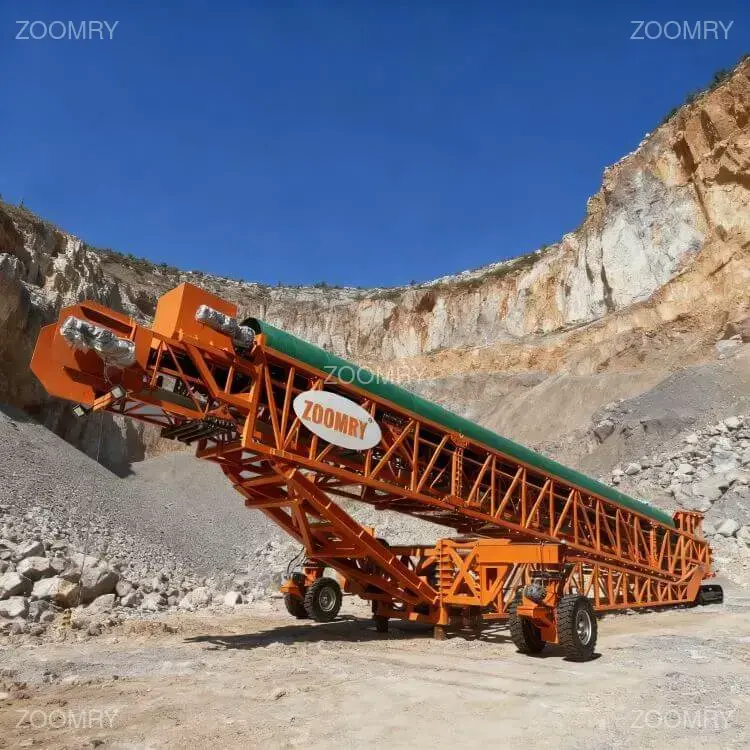
ZR80SF stacker conveyor with radial, telescopic and luffing functions....
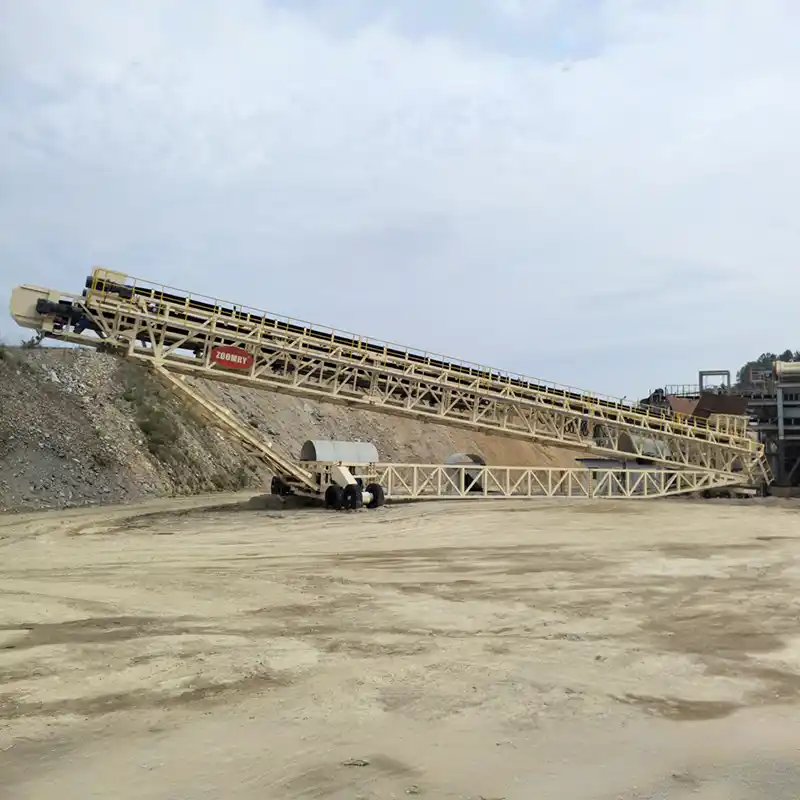
Telescopic stacker for stockyard stacking, reclaiming and truck/ship l...
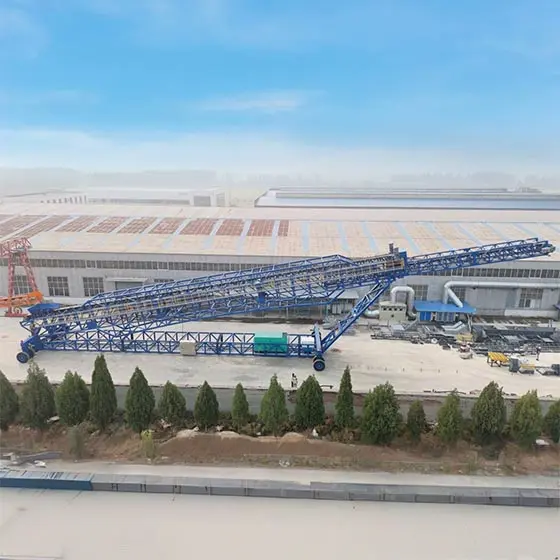
Ship loading conveyors for fixed dock-to-vessel bulk transfer. Continu...
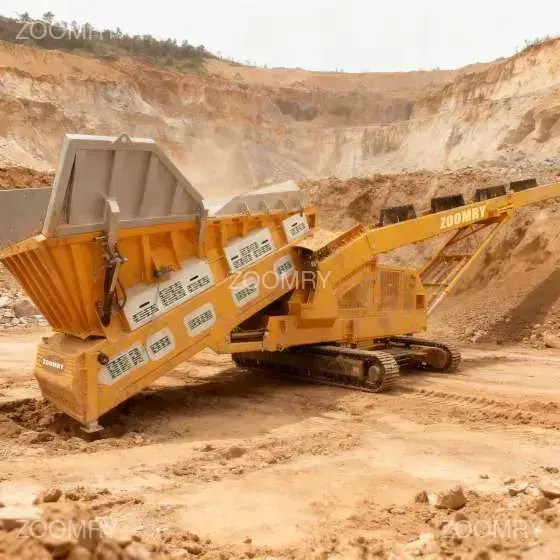
Low feed hopper feeder with 7-12 m³ capacity, up to 800 t/h. Low feed-...

Enter your email to contact us quickly!
Copyright © 2002-2026 Zoomry Group Company Limited 非商用版本 AI Index